1. A brief (500 words or less) description of your proposed event/project/reason for requesting the mini-grant funding.
In Writing & Rhetoric II, students work the entire semester toward a 12- to 15-page researched discovery essay. This semester, we will require our students to select a topic or line of inquiry that falls under the umbrella of Fact & Faith.
We, Kristen Orser, Maureen Ewing, and Kate Dougherty, would like our selected Writing & Rhetoric II students (2 from each class, 6 total) to present Fact & Faith essay findings at a Critical Encounters event symposium at the end of the Spring 2010 semester.
We’d like their bound essay abstracts (all three classes bound together) and their bound essays (one book for each class) to be available to Columbia faculty, staff, administration, and students, and for our students’ friends and family who attend the event.
As writing instructors, we encourage our students to imagine their intended audience. We believe that creating an actual audience – the readers of their texts and those who attend their symposium – will aid our students’ learning and make their writing more purposeful to both them and the Columbia College community.
We request the mini-grant funding to cover the cost of binding students’ abstracts and essays. The expenses are outlined below, but we’ve found an economical way to bind through Xerox: Xerox prints for free, and it costs just $1.55/copy for binding. Remaining funds would allow us to document and archive the project for future use for Critical Encounters and the First Year Writing Program. We’ll need to pay a videographer to document the symposium and pay the library for archival quality inks and paper to document our students’ writing. We’d like to also provide modest catering at the event.
Interim First Year Writing Program Director Dr. Ames Hawkins has agreed that the program’s budget will match funds in support of the Critical Encounters mini-grant application.
2. A statement regarding the way your event/project will enhance Critical Encounters.
By publishing our students’ researched discovery essays in response to Critical Encounters: Fact & Faith, Columbia will obtain documentation that reveals how students engage with Critical Encounters’ topics in a meaningful way. Their writing will show that Critical Encounters is worthwhile fodder for a writing classroom. Our students’ writing and their recorded symposium will create a digital archive for the library.
Our students will communicate about their essays and Fact & Faith throughout the semester through a blog. We can link their blog to the Critical Encounters blog, which might be of use to other classes engaging Fact & Faith. These classes might have reason or interest to attend our symposium.
The symposium will offer a unique opportunity for first-year students to be involved in Critical Encounters. As they continue with their coursework at Columbia, they will have an enhanced understanding of the time and effort that goes into creating a Critical Encounters event. They will feel more connected to Critical Encounters and more likely to become involved in the initiative as an active participant and audience member in the future. Their involvement in the symposium will also encourage other students, friends, and family to attend the Critical Encounters event. The students’ family and friends will have a better understanding of the sort of community that Critical Encounters helps foster at Columbia.
3. An estimated budget.
We’d like to bind our students’ essays, as well as abstracts for their essays, so that they are available both for the students who’ve written them and for other interested parties – the students’ family and friends, other Columbia students, Critical Encounters faculty and staff, other Columbia faculty and staff, and Columbia administration.
Xerox prints for free. It costs $1.55 to bind each book.
Kate Dougherty’s Enhanced Writing & Rhetoric II: 12 students
Kristen Orser’s Writing & Rhetoric II: 18 students
Maureen Ewing’s Writing & Rhetoric II: 18 students
Total: 48 participating students
Expenses
1.) Book collecting the students’ completed essays:
Each of the three classes will have their own books, so each unit below is a multiple of three.
(48 students + 3 instructor copies) x $1.55 binding fee = $79.05
15 faculty/staff/admin. (5 available for each class) x $1.55 binding fee = $23.25
24 friends/family/students (8 available for each class) x $1.55 binding fee = $37.20
Subtotal: $139.50
2.) Book collecting students’ abstracts:
(48 students + 3 instructor copies) x $1.55 binding fee = $79.05
10 faculty/staff/admin. x $1.55 binding fee = $15.50
10 family/friends/students x $1.55 binding fee = $15.50
Subtotal: $110.05
Subtotal to print books: $249.55
$250.45 remaining for #3-6.
3.) Videographer at symposium:
Covered by Critical Encounters budget (according to Eric Scholl, First Year Writing plenary, 1/22/10).
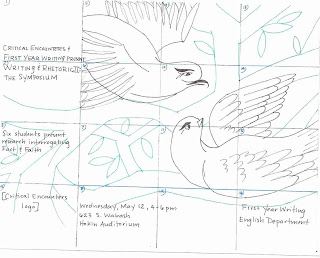
4.) Advertisements (10 posters on gloss paper that advertise symposium with Columbia logo, Critical Encounters logo, and First Year Writing Program):
Covered by Critical Encounters budget (according to Eric Scholl, First Year Writing plenary, 1/22/10). We plan to contact CPS with text and images 4-6 weeks before we’d like the posters printed during Week 6, Monday, March 1, 2010.
5.) Invitations for Columbia faculty, staff, and administration:
Covered by Critical Encounters budget (according to Eric Scholl, First Year Writing plenary, 1/22/10). We plan to contact CPS with text and images 4-6 weeks before we’d like the posters printed during Week 8, Monday, March 15, 2010.
6.) Catering (fruit, cheese, crackers, drinks for 60-70) at symposium: ____________
Any remaining funds could be reserved for additionally requested texts of student writing.
Interim First Year Writing Program Director Dr. Ames Hawkins has agreed that the program’s budget will match funds in support of the Critical Encounters mini-grant application.
Critical Encounters Fellow Eric Scholl's response to our application
Thanks for applying for the Critical Encounters minigrant. We'd love to support this very worthwhile project.
The $249 for the books is totally fine. We pay these grants through reimbursements, so if you could send us receipts as you incur expenses, that would be great.
The other $251 I had some questions about. You listed posters & invitations, which we can help you design & which we can get printed without cost. I would need some image suggestions or actual images very soon to get the ball rolling. Also, for video, we usually pay a shooter to tape our events. Would you like us to do that for this? And if so, should I assume you would not need funding for those two aspects of the project?
I am looking into food. As you've probably heard, Columbia is not so crazy about paying for food these days, but I'll see what I can do. So, I'd say start spending the $250 now for the book, get me some images & info on verbiage for the posters & invitations, and I can arrange a shooter. I'll let you know as soon as I get an answer on food.